
Servoelectric Road Simulators
Servoelectric Road Simulators for Vehicle Durability Simulation
At eMpulse Test Systems, our servoelectric road simulators precisely replicate real-world driving conditions, from urban streets to off-road environments. These vehicle road simulation systems are engineered to support accurate vehicle durability simulation by reproducing real road inputs through controlled, repeatable motion. With configurations up to 108kN, they simulate varied road surfaces, terrains, and environmental factors, including 4-post road simulator configurations for full-vehicle testing, supporting 4-Poster, body-coupled, and aero loading applications.
Engineered for high accuracy and efficiency, our systems integrate with acoustic and climatic chambers for NVH, temperature, humidity, and solar testing. Utilizing SEA technology, they deliver superior control, reduced maintenance, and up to 80% energy savings over hydraulic systems. By combining precise actuation with road load data acquisition, these road simulators enable engineers to reproduce measured road inputs with high fidelity. The seaPLUS series boosts efficiency by 46%, further extending performance, durability, and testing capabilities. Designed to meet SAE, ISO, and other industry standards, these vehicle road simulation systems provide reliable, high-fidelity testing across durability, NVH, and production validation programs.
- Durability
- Noise, Vibration, and Harshness (NVH)
- Research and Development
- Buzz Squeak, and Rattle (BSR)
- End-of-Line Production
- Accelerated Life
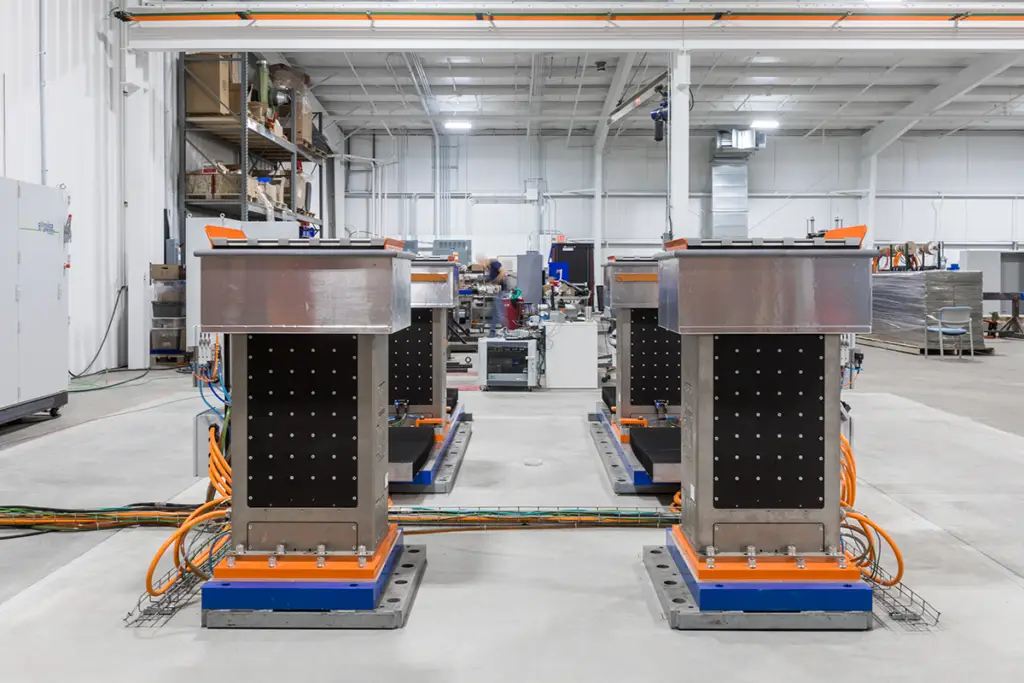
Advantages of Servoelectric Road Simulators
Extended Wheelpans
Pedestal style servoelectric linear motors are fitted with extended wheelpans for vertical motion into the tire patch for the typical Four Poster system configuration, allowing accurate force input at the tire interface for 4-Post road simulator testing.
Thermal Management for Extended Testing
Increased efficiency in converting electrical to mechanical energy, results in significantly lower heat generation. This improved efficiency reduces the size of the active cooling infrastructure, minimizes thermal loading on components, and contributes to lower overall operational costs, supporting long-duration vehicle durability simulation programs.
Body Coupled Actuation
Additional body coupled actuators can inject higher frequency vibration directly into the vehicle frame, enhancing vehicle road simulation systems by reproducing structural excitation beyond tire inputs.
Tired Coupled Actuation
Available in configurations for 2, 3, 4 or more tire coupled actuators, in addition to direct body coupled actuators or aeroloaders.
High-Frequency Capability
Motor coherence up to 400 Hz enables test profiles that demand high dynamic response, exceeding the capabilities of servo-hydraulic actuators, and supporting accurate reproduction of road load data acquisition inputs.
Force Range and Modular Design
Modular motor configurations deliver peak dynamic forces from 1 kN to 108 kN, independent of static load.
Nanometer-Level Accuracy
Integrated displacement feedback systems offer <10 nm resolution, supporting high-precision test requirements, which is critical when replaying measured road load data in durability simulations.
Pneumatic Static Load Support
Supports the vehicle weight, which allows the motors to provide the full dynamic force capacity independent of vehicle weight.
Pneumatic Support
Patented Integrated high volume Air-bag pneumatic support system for no maintenance and long-term durability.
Solid Welded Construction
Precision CNC machined and ground surfaces to 0.0001” tolerances to ensure perfect alignment for system longevity. Nickel plating surfaces resist long-term corrosion better than zinc, powder-coating or paint.
Track-Width Fit
Wide actuator and wheelpan with outboard bearing placement accommodates nearly all vehicle sizes and completely eliminates the need for Track-width adjustment system in most cases, reducing setup time for multi-vehicle road simulator programs.
Internal Cooling Motors
Internal motor cooling allows higher continuous force capacity to run extended or durability test profiles, supporting continuous operation in demanding vehicle road simulation systems.
High Fidelity
High fidelity 32-bit closed-loop control ensures smooth, accurate motion across all test speeds, without switching valve types or control strategies, delivering repeatable results across durability and NVH test campaigns.
Application-Specific Software
Integrated with eMpulse controls that feature application-specific software, seaPLUS Road Simulators are ideal for field data reproduction, sine sweep, or Power Spectral Density (PSD) profile replication.
Efficient, Clean Operation
Direct-drive electric motion is up to 80% more efficient than hydraulics, with no fluid handling, reduced maintenance, and a cleaner test environment.
Integrated Safety Features
These features are built into the control architecture to ensure operator safety and specimen integrity during every test cycle. Every system includes comprehensive safety monitoring:
Servoelectric Road Simulators
Servoelectric Road Simulators for Vehicle Durability Simulation
At eMpulse Test Systems, our servoelectric road simulators precisely replicate real-world driving conditions, from urban streets to off-road environments. These vehicle road simulation systems are engineered to support accurate vehicle durability simulation by reproducing real road inputs through controlled, repeatable motion. With configurations up to 108kN, they simulate varied road surfaces, terrains, and environmental factors, including 4-post road simulator configurations for full-vehicle testing, supporting 4-Poster, body-coupled, and aero loading applications.
Engineered for high accuracy and efficiency, our systems integrate with acoustic and climatic chambers for NVH, temperature, humidity, and solar testing. Utilizing SEA technology, they deliver superior control, reduced maintenance, and up to 80% energy savings over hydraulic systems. By combining precise actuation with road load data acquisition, these road simulators enable engineers to reproduce measured road inputs with high fidelity. The seaPLUS series boosts efficiency by 46%, further extending performance, durability, and testing capabilities. Designed to meet SAE, ISO, and other industry standards, these vehicle road simulation systems provide reliable, high-fidelity testing across durability, NVH, and production validation programs.
- Durability
- Noise, Vibration, and Harshness (NVH)
- Research and Development
- Buzz Squeak, and Rattle (BSR)
- End-of-Line Production
- Accelerated Life
Servoelectric Road Simulators
- Durability
- Research and Development
- Noise, Vibration, Harshness (NVH)
- Buzz, Squeak, and Rattle (BSR)
- End-of-Line Production
- Accelerated Life
- 13kN
- 27kN
- 40kN
- 54kN
- 108kN
Advantages of Servoelectric Road Simulators
Extended Wheelpans
Pedestal style servoelectric linear motors are fitted with extended wheelpans for vertical motion into the tire patch for the typical Four Poster system configuration, allowing accurate force input at the tire interface for 4-Post road simulator testing.
Thermal Management for Extended Testing
Increased efficiency in converting electrical to mechanical energy, results in significantly lower heat generation. This improved efficiency reduces the size of the active cooling infrastructure, minimizes thermal loading on components, and contributes to lower overall operational costs, supporting long-duration vehicle durability simulation programs.
Body Coupled Actuation
Additional body coupled actuators can inject higher frequency vibration directly into the vehicle frame.
Tired Coupled Actuation
Available in configurations for 2, 3, 4 or more tire coupled actuators, in addition to direct body coupled actuators or aeroloaders.
High-Frequency Capability
Motor coherence up to 400 Hz enables test profiles that demand high dynamic response, exceeding the capabilities of servo-hydraulic actuators, and supporting accurate reproduction of road load data acquisition inputs.
Force Range and Modular Design
Modular motor configurations deliver peak dynamic forces from 1 kN to 108 kN, independent of static load.
Nanometer-Level Accuracy
Integrated displacement feedback systems offer <10 nm resolution, supporting high-precision test requirements, which is critical when replaying measured road load data in durability simulations.
Pneumatic Static Load Support
Supports the vehicle weight, which allows the motors to provide the full dynamic force capacity independent of vehicle weight.
Pneumatic Support
Patented Integrated high volume Air-bag pneumatic support system for no maintenance and long-term durability.
Solid Welded Construction
Precision CNC machined and ground surfaces to 0.0001” tolerances to ensure perfect alignment for system longevity. Nickel plating surfaces resist long-term corrosion better than zinc, powder-coating or paint.
Track-Width Fit
Wide actuator and wheelpan with outboard bearing placement accommodates nearly all vehicle sizes and completely eliminates the need for Track-width adjustment system in most cases, reducing setup time for multi-vehicle road simulator programs.
Internal Cooling Motors
Internal motor cooling allows higher continuous force capacity to run extended or durability test profiles, supporting continuous operation in demanding vehicle road simulation systems.
High Fidelity
High fidelity 32-bit closed-loop control ensures smooth, accurate motion across all test speeds, without switching valve types or control strategies, delivering repeatable results across durability and NVH test campaigns.
Application-Specific Software
Integrated with eMpulse controls that feature application-specific software, seaPLUS Road Simulators are ideal for field data reproduction, sine sweep, or Power Spectral Density (PSD) profile replication.
Efficient, Clean Operation
Direct-drive electric motion is up to 80% more efficient than hydraulics, with no fluid handling, reduced maintenance, and a cleaner test environment.
Integrated Safety Features
These features are built into the control architecture to ensure operator safety and specimen integrity during every test cycle. Every system includes comprehensive safety monitoring:
Servoelectric Road Simulators
- Durability
- Research and Development
- Noise, Vibration, Harshness (NVH)
- Buzz, Squeak, and Rattle (BSR)
- End-of-Line Production
- Accelerated Life
- 13kN
- 27kN
- 40kN
- 54kN
- 108kN
View eMpulse’s road simulator test system in use at an independent testing facility in Germany.
Advantages of Servoelectric Road Simulators
Extended Wheelpans
Pedestal style servoelectric linear motors are fitted with extended wheelpans for vertical motion into the tire patch for the typical Four Poster system configuration, allowing accurate force input at the tire interface for 4-Post road simulator testing.
Thermal Management for Extended Testing
Increased efficiency in converting electrical to mechanical energy, results in significantly lower heat generation. This improved efficiency reduces the size of the active cooling infrastructure, minimizes thermal loading on components, and contributes to lower overall operational costs, supporting long-duration vehicle durability simulation programs.
Body Coupled Actuation
Additional body coupled actuators can inject higher frequency vibration directly into the vehicle frame, enhancing vehicle road simulation systems by reproducing structural excitation beyond tire inputs.
Tired Coupled Actuation
Available in configurations for 2, 3, 4 or more tire coupled actuators, in addition to direct body coupled actuators or aeroloaders.
High-Frequency Capability
Motor coherence up to 400 Hz enables test profiles that demand high dynamic response, exceeding the capabilities of servo-hydraulic actuators, and supporting accurate reproduction of road load data acquisition inputs.
Force Range and Modular Design
Modular motor configurations deliver peak dynamic forces from 1 kN to 108 kN, independent of static load.
Nanometer-Level Accuracy
Integrated displacement feedback systems offer <10 nm resolution, supporting high-precision test requirements, which is critical when replaying measured road load data in durability simulations.
Pneumatic Static Load Support
Supports the vehicle weight, which allows the motors to provide the full dynamic force capacity independent of vehicle weight.
Pneumatic Support
Patented Integrated high volume Air-bag pneumatic support system for no maintenance and long-term durability.
Solid Welded Construction
Precision CNC machined and ground surfaces to 0.0001” tolerances to ensure perfect alignment for system longevity. Nickel plating surfaces resist long-term corrosion better than zinc, powder-coating or paint.
Track-Width Fit
Wide actuator and wheelpan with outboard bearing placement accommodates nearly all vehicle sizes and completely eliminates the need for Track-width adjustment system in most cases, reducing setup time for multi-vehicle road simulator programs.
Internal Cooling Motors
Internal motor cooling allows higher continuous force capacity to run extended or durability test profiles, supporting continuous operation in demanding vehicle road simulation systems.
High Fidelity
High fidelity 32-bit closed-loop control ensures smooth, accurate motion across all test speeds, without switching valve types or control strategies, delivering repeatable results across durability and NVH test campaigns.
Application-Specific Software
Integrated with eMpulse controls that feature application-specific software, seaPLUS Road Simulators are ideal for field data reproduction, sine sweep, or Power Spectral Density (PSD) profile replication.
Efficient, Clean Operation
Direct-drive electric motion is up to 80% more efficient than hydraulics, with no fluid handling, reduced maintenance, and a cleaner test environment.
Integrated Safety Features
These features are built into the control architecture to ensure operator safety and specimen integrity during every test cycle. Every system includes comprehensive safety monitoring:
Servoelectric Road Simulator Specifications
|
Specifications Typical Applications |
Symbol | units |
sea+ 13 Body Coupled* |
sea+ 27 NVH 4-POST* |
sea+ 40 4-POST Durability* |
sea+ 54 4-Post Durability* |
sea+ 108 4-Post Durability* |
||||
|---|---|---|---|---|---|---|---|---|---|---|---|
|
xxx= A Stroke |
S |
m (in) |
330* |
160
(6.3) |
260
(10.2) |
160
(6.3) |
260
(10.2) |
160
(6.3) |
260
(10.2) |
160
(6.3) |
260
(10.2) |
|
Motor Dynamic Peak Force |
Fpk, mot |
N (lbF) |
13486 (3028) |
26910 (6050) |
40326 (9066) |
53820 (12100) |
107640 (24200) |
||||
|
Motor Continuous Dynamic Force** |
Fn, mot |
N (lbF) |
5018 |
10530 (2367) |
21060 (4735) |
21060 (4735) |
42120 (9469) |
||||
|
Static Load Support |
Fpk, air |
N (lbF) |
8900 (2000) |
17800 |
17800 |
17800 |
35600 |
||||
|
Total Continuous Force |
Fpk, total |
N (lbF) |
13918 |
28330 |
38860 |
38860 |
77720 |
||||
|
Total Peak Force |
Fn,cont, tot |
N (lbF) |
22368 |
44710 (10052) |
58126 |
71620 |
143240 |
||||
Energy Efficiency
eMpulse’s systems are known for their energy efficiency, reliability, and sustainability in industrial testing applications. Integrating SEA technology enhances testing processes and leads to overall operational improvements such as lowered energy use, reduced maintenance, and improved control.

Energy Efficiency
Durability + Servoelectric Actuation
Our servoelectric systems are excellent for durability testing needs. Our systems, using liquid cooled electric motors, can operate with high precision over extended periods, servoelectric actuation offers substantial operational advantages.

Durability + Servoelectric Actuation
Our servoelectric systems are excellent for durability testing needs. Our systems, using liquid cooled electric motors, can operate with high precision over extended periods, servoelectric actuation offers substantial operational advantages.
Facility Integration
eMpulse offers comprehensive turn-key facility integration services to meet the needs of our clients. We can develop facility integration plans directly or collaborate with your architectural engineering firm.
- Reaction Mass
- Wheelbase Adjustment
- Actuators
- And More
Sustainability
Our technology reduces energy consumption and environmental impact, contributing to a greener future. Discover how our innovative solutions can help you achieve your sustainability goals.
- No Hydraulic Fluids
- Lower Energy Consumption
- Lower Emissions
- Regenerative Energy
Facility Integration
eMpulse offers comprehensive turn-key facility integration services to meet the needs of our clients. We can develop facility integration plans directly or collaborate with your architectural engineering firm.
- Reaction Mass
- Wheelbase Adjustment
- Actuators
- And More
Sustainability
Our technology reduces energy consumption and environmental impact, contributing to a greener future. Discover how our innovative solutions can help you achieve your sustainability goals.
- No Hydraulic Fluids
- Lower Energy Consumption
- Lower Emissions
- Regenerative Energy
Servoelectric Road Simulator Specifications
|
Specifications Typical Applications |
Symbol | units |
sea+ 13 Body Coupled* |
sea+ 27 NVH 4-POST* |
sea+ 40 4-POST Durability* |
sea+ 54 4-Post Durability* |
sea+ 108 4-Post Durability* |
||||
|---|---|---|---|---|---|---|---|---|---|---|---|
|
xxx= A Stroke |
S |
m (in) |
330* |
160
(6.3) |
260
(10.2) |
160
(6.3) |
260
(10.2) |
160
(6.3) |
260
(10.2) |
160
(6.3) |
260
(10.2) |
|
Motor Dynamic Peak Force |
Fpk, mot |
N (lbF) |
13486 (3028) |
26910 (6050) |
40326 (9066) |
53820 (12100) |
107640 (24200) |
||||
|
Motor Continuous Dynamic Force** |
Fn, mot |
N (lbF) |
5018 |
10530 (2367) |
21060 (4735) |
21060 (4735) |
42120 (9469) |
||||
|
Static Load Support |
Fpk, air |
N (lbF) |
8900 (2000) |
17800 |
17800 |
17800 |
35600 |
||||
|
Total Continuous Force |
Fpk, total |
N (lbF) |
13918 |
28330 |
38860 |
38860 |
77720 |
||||
|
Total Peak Force |
Fn,cont, tot |
N (lbF) |
22368 |
44710 (10052) |
58126 |
71620 |
143240 |
||||
Frequently Asked Questions
Road simulators let engineers reproduce real driving loads in a controlled lab environment. In practice, they’re most often used to accelerate durability testing, reduce proving-ground time, and study vehicle response under repeatable conditions that would be difficult — or expensive — to recreate on the road.
Road simulators , including 4-Posters, reproduce real-world road inputs or synthetic signals in a controlled laboratory environment. By applying vertical motion at each wheel location, systems such as 4-poster and other multi-actuator configurations can reproduce measured road data and evaluate how a full vehicle or structure responds to real operating conditions without leaving the lab. Road simulators allow engineers to perform a large portion of durability, structural, and ride evaluations in a repeatable and highly controlled setting.
Road load data acquisition starts with instrumented vehicles driven over real roads or test tracks. Forces, displacements, and accelerations are recorded, then processed and replayed on the road simulator. The goal isn’t just to “shake the car,” but to reproduce the same load histories in a repeatable way.
Road simulators can be configured to test a wide range of vehicles and structures, including passenger cars, electric vehicles, commercial trucks, off-highway equipment, and specialized platforms. System capability depends on actuator force capacity, stroke, and overall system configuration. With the appropriate setup, these systems can also be used to evaluate subsystems or structural components when full-vehicle testing is not required.
They allow engineers to compress years of real-world driving into weeks or months of lab testing. More importantly, the same test can be repeated exactly — something that’s nearly impossible on a proving ground where weather, traffic, and surface conditions constantly change.
Road simulators can be combined with acoustic or climatic chambers to study Noise, Vibration, and Harshness under realistic loading. This lets teams evaluate NVH behavior early and under controlled conditions, instead of waiting for subjective feedback late in a program. This type of testing is also called Buzz, Squeak and Rattle.
Servoelectric road simulators are often selected for their precise control, lower maintenance requirements, and cleaner operation. Because they do not rely on hydraulic power units or fluid management systems, they create a quieter and more efficient lab environment while reducing infrastructure complexity. Modern servoelectric systems can also deliver substantial force and dynamic performance, making them well suited for many vehicle durability, ride, and structural testing applications.
They can be, particularly for validation and quality checks on representative vehicles. While they’re more commonly associated with development and durability programs, some manufacturers use them to catch structural or assembly issues before vehicles are released.
When road load data is properly acquired and processed, correlation to proving-ground results can be very strong. The main advantage is consistency — the simulator runs the same test every time, making comparisons and root-cause analysis much easier than relying on repeated track testing.
A 4-post system makes the most sense when vertical wheel loads dominate durability concerns and when repeatability is critical. It’s especially effective for accelerated testing programs where reducing proving-ground time is a priority, rather than replacing all physical road testing outright.
Frequently Asked Questions
Road simulators let engineers reproduce real driving loads in a controlled lab environment. In practice, they’re most often used to accelerate durability testing, reduce proving-ground time, and study vehicle response under repeatable conditions that would be difficult — or expensive — to recreate on the road.
Road simulators , including 4-Posters, reproduce real-world road inputs or synthetic signals in a controlled laboratory environment. By applying vertical motion at each wheel location, systems such as 4-poster and other multi-actuator configurations can reproduce measured road data and evaluate how a full vehicle or structure responds to real operating conditions without leaving the lab. Road simulators allow engineers to perform a large portion of durability, structural, and ride evaluations in a repeatable and highly controlled setting.
Road load data acquisition starts with instrumented vehicles driven over real roads or test tracks. Forces, displacements, and accelerations are recorded, then processed and replayed on the road simulator. The goal isn’t just to “shake the car,” but to reproduce the same load histories in a repeatable way.
Road simulators can be configured to test a wide range of vehicles and structures, including passenger cars, electric vehicles, commercial trucks, off-highway equipment, and specialized platforms. System capability depends on actuator force capacity, stroke, and overall system configuration. With the appropriate setup, these systems can also be used to evaluate subsystems or structural components when full-vehicle testing is not required.
They allow engineers to compress years of real-world driving into weeks or months of lab testing. More importantly, the same test can be repeated exactly — something that’s nearly impossible on a proving ground where weather, traffic, and surface conditions constantly change.
Road simulators can be combined with acoustic or climatic chambers to study Noise, Vibration, and Harshness under realistic loading. This lets teams evaluate NVH behavior early and under controlled conditions, instead of waiting for subjective feedback late in a program. This type of testing is also called Buzz, Squeak and Rattle.
Servoelectric road simulators are often selected for their precise control, lower maintenance requirements, and cleaner operation. Because they do not rely on hydraulic power units or fluid management systems, they create a quieter and more efficient lab environment while reducing infrastructure complexity. Modern servoelectric systems can also deliver substantial force and dynamic performance, making them well suited for many vehicle durability, ride, and structural testing applications.
They can be, particularly for validation and quality checks on representative vehicles. While they’re more commonly associated with development and durability programs, some manufacturers use them to catch structural or assembly issues before vehicles are released.
When road load data is properly acquired and processed, correlation to proving-ground results can be very strong. The main advantage is consistency — the simulator runs the same test every time, making comparisons and root-cause analysis much easier than relying on repeated track testing.
A 4-post system makes the most sense when vertical wheel loads dominate durability concerns and when repeatability is critical. It’s especially effective for accelerated testing programs where reducing proving-ground time is a priority, rather than replacing all physical road testing outright.
Our servoelectric systems are excellent for durability testing needs. Our systems, using liquid cooled electric motors, can operate with high precision over extended periods, servoelectric actuation offers substantial operational advantages.
Facility Integration
eMpulse offers comprehensive turn-key facility integration services to meet the needs of our clients. We can develop facility integration plans directly or collaborate with your architectural engineering firm.
- Reaction Mass
- Wheelbase Adjustment
- Actuators
- And More
Sustainability
Our advanced technology reduces energy consumption and environmental impact, contributing to a greener future. Discover how our innovative solutions can help you achieve your sustainability goals.
- No Hydraulic Fluids
- Lower Energy Consumption
- Lower Emissions
- Regenerative Energy