Servoelectric Multi Axis Systems
Servoelectric Multi Axis Test Systems and Simulation Tables
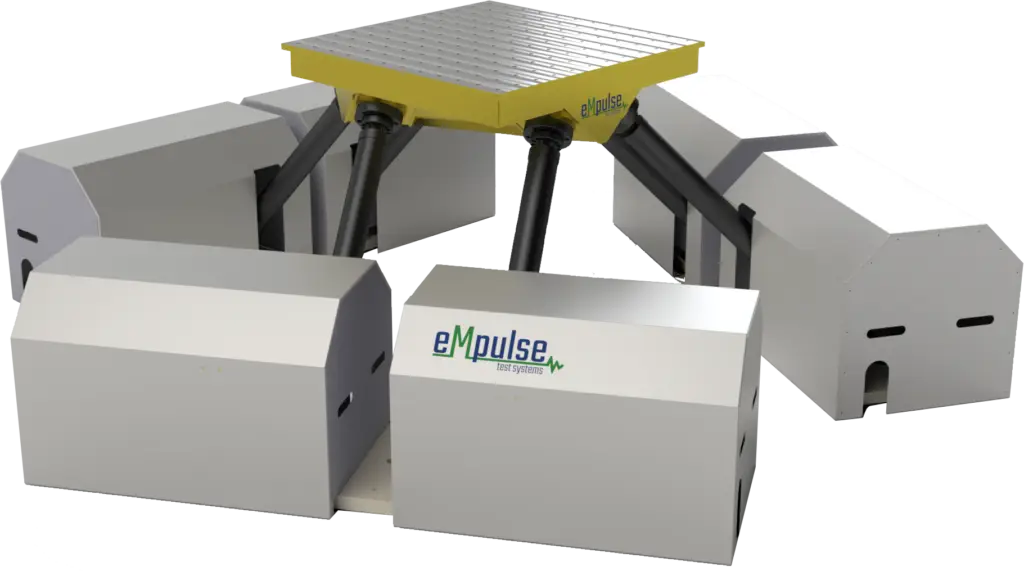
At eMpulse Test Systems, our servoelectric Multi-Axis Simulation Tables (MAST) are advanced multi-axis test systems designed to accurately replicate complex dynamic motion, simulating real-world vibrations, stress, and strain experienced by products across industries. With 3 and 6 degrees of freedom (6-DOF) tables, these servoelectric multi-axis testing systems provide precise multi-axial force and motion control, accommodating hexapod, orthogonal, and custom configurations to meet diverse testing requirements.
Utilizing SEA technology, eMpulse MAST systems deliver higher fidelity, reduced maintenance, and up to 80% energy savings over hydraulic alternatives. Integrated with advanced control algorithms, these servoelectric multi-axis test systems enable closed-loop force and motion control, high-frequency response, and precise multi-axis motion replication for demanding simulation and durability test programs.
eMpulse 3-DOF systems are designed for precise multi-axis testing of components and assemblies, allowing simultaneous linear and rotational motion control for realistic simulation of real-world loading conditions. Configured to provide motion in vertical, lateral, and longitudinal axes, these multi-axis test systems accurately replicate complex force interactions and structural responses, making them invaluable for NVH, structural integrity, and durability testing.
- Durability
- Noise, Vibration, and Harshness (NVH)
- Ride Comfort
- Modal Correlation
- SAE and ISO Test Specifications
Advantages of Servoelectric Multi Axis Systems
Extended Stroke and Velocity
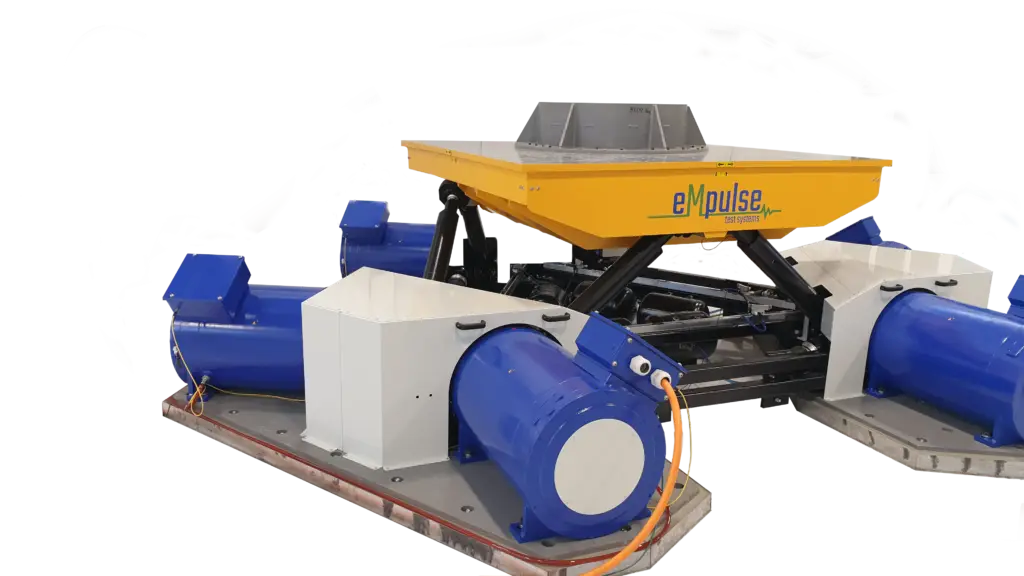
Servo electric linear or rotary motors provide the actuation to drive multi axis simulation tables in a variety of different geometric configurations. Common system arrangements include both orthogonal or hexapod 6 Degrees Of Freedom (6 DOF), which provide X, Y, Z linear and Roll, Pitch, and Yaw rotational motions. Also available in other configurations, including linear only 3 Degrees Of Freedom (3DOF), for X,Y,Z motion profiles.
High Fidelity Feedback and Control
High precision 32-bit closed-loop control ensures smooth, accurate motion across all test speeds, supporting multi axis test execution and data correlation without switching valve types or control strategies.
High-Frequency Capability
Motor coherence up to 400 Hz enables test profiles that demand high dynamic response, exceeding the capabilities of servo-hydraulic actuators.
Solid Welded Construction
Precision CNC machined and ground surfaces to 0.0001” tolerances to ensure perfect alignment for system longevity. Nickel plating surfaces resist long-term corrosion better than zinc, powder-coating or paint.
Force Range and Modular Design
Modular motor configurations deliver a wide range of table sizes and payload capabilities all the way up to 1000kg.
Nanometer-Level Accuracy
Integrated displacement feedback systems offer <10 nm resolution, supporting high-precision test requirements.
Sideload Capacity
Outboard bearings significantly improve sideload tolerance, outperforming comparable servohydraulic systems in lateral stability and reliability.
Reliable and Flexible Design
Liquid cooled rotary motors with link arms combined with stingers allow us to achieve the right balance between available travel and peak acceleration
Pneumatic Support
Pneumatic Static Load Support supports the specimens and table weight, which allows the motors to provide the full dynamic force capacity independent of static weight.
Application-Specific Software
Integrated with eMpulse controls that feature application-specific software, seaPLUS MAST systems support multi axis data replication, sine sweep testing, and PSD-based vibration profiles, make them ideal for advanced servolectric multi axis testing.
Thermal Management
Increased efficiency in converting electrical to mechanical energy, results in significantly lower heat generation. This improved efficiency reduces the size of the active cooling infrastructure, minimizes thermal loading on components, and contributes to lower overall operational costs.
Efficient, Clean Operation
Direct-drive electric motion is up to 80% more efficient than hydraulics, with no fluid handling, reduced maintenance, and a cleaner test environment.
Integrated Safety Features
These features are built into the control architecture to ensure operator safety and specimen integrity during every test cycle. Every system includes comprehensive safety monitoring:
Servoelectric Multi Axis Tests
- Durability
- Noise, Vibration, Harshness (NVH)
- Ride Comfort
- Modal Correlation
- SAE and ISO Test Specifications
Servoelectric Multi Axis Test Specifications
| Specifications | units | 15-1S | 15-1S-HP | 35-2S | 69-2.2S |
|---|---|---|---|---|---|
|
Table Size |
m |
1.2 x 1.2 |
1.2 x 1.2 |
2.0 x 2.0 |
2.0 x 2.0 |
|
Minimum Simulation Frequency Range |
Hz |
>0-200 |
>0-400 |
>0-200 |
>0-200 |
|
Rated Payload |
Kg |
500 |
400 |
500 |
1000 |
|
Actuator Peak Force |
KN |
15.4 |
15.4 |
34.5 |
69 |
|
Linear Displacement (total Pk-Pk) Lateral (Y) Vertical (Z) |
|
|
|
|
|
|
Angular Displacement (total Pk-Pk) |
|
|
|
|
|
Frequently Asked Questions
A servoelectric multi-axis test system applies controlled motion and loads in multiple directions at the same time. Instead of testing one axis in isolation, these systems are used when real-world behavior involves coupled forces – the kind you can’t realistically break into single-axis tests without losing important interactions.
Single-axis testing works well when loads are well understood and largely directional. Multi-axis testing becomes important when components or assemblies experience simultaneous forces, rotations, or vibrations that interact with each other. In those cases, isolating one axis at a time can miss failure modes or distort results.
Degrees of freedom describe how many independent motions the system can control.
A 3-DOF system controls linear motion in X, Y, and Z.
A 6-DOF system adds rotation – roll, pitch, and yaw.
Six degrees of freedom are typically used when motion fidelity, correlation to field data, or realistic vibration environments are critical.
A hexapod uses six actuators arranged in a geometry that allows control of six degrees of freedom. This architecture is often chosen for its compact footprint, high stiffness, and precise motion control. It’s especially useful when accuracy and coordinated motion matter more than extreme stroke length.
Orthogonal systems arrange actuators along independent linear axes. This approach offers more flexibility when stroke length, payload size, or specific dynamic performance needs drive the design. They’re often selected when the test article is large, heavy, or requires tuning that isn’t as easily achieved with a hexapod geometry.
Multi-axis systems show up in applications like NVH evaluation, structural dynamics, modal correlation, durability testing, ride comfort studies, and field data replication. They’re common in automotive, aerospace, defense, and industrial R&D environments where realistic motion matters more than test simplicity.
Servoelectric systems are often preferred for their control fidelity, repeatability, and lower maintenance burden. They also consume less energy and avoid hydraulic fluids, which simplifies facility integration. Servoelectric systems cover many multi-axis applications cleanly and efficiently.
Yes — assuming the field data is properly collected and processed. Multi-axis systems can replay measured vibration and motion inputs using time histories, sine sweeps, or PSD profiles. The advantage is repeatability: the same input can be run again and again under identical conditions.
Servoelectric systems are often preferred for their control fidelity, repeatability, and lower maintenance requirements. Their fully electric architecture provides precise digital control across multiple axes while eliminating hydraulic power units and fluid management systems. This reduces infrastructure complexity, lowers energy consumption, and creates a cleaner, quieter testing environment. Modern servoelectric platforms can also deliver substantial force and dynamic performance, making them well suited for a wide range of multi-axis durability, vibration, and structural testing applications.
Payload capacity varies widely based on table size, actuator selection, and system architecture. Some systems are designed for component-level testing, while others support large assemblies or substructures. Matching payload and performance requirements early is critical to system selection.
They are. These systems are designed for high duty cycles and extended operation, with features like efficient thermal management and closed-loop control to maintain stable performance during long-duration durability or vibration testing.
There’s no single answer. Selection usually comes down to degrees of freedom, payload mass, frequency range, stroke, acceleration requirements, test profiles, and facility constraints. Working through those tradeoffs early — ideally with application engineers — helps avoid over- or under-specifying the system.
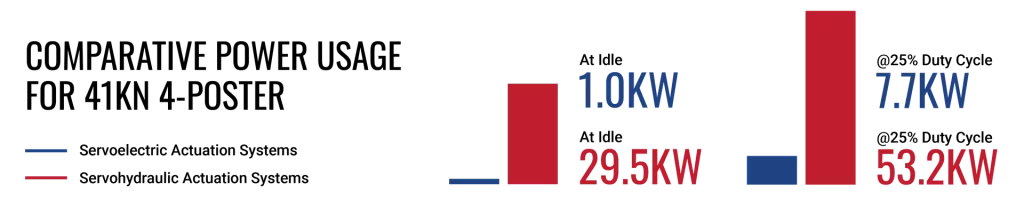
Our servoelectric systems are excellent for durability testing needs. Using liquid cooled electric motors, these servoelectric multi axis test systems operate with high precision over extended periods, offering substantial advantages in repeatability, uptime, and energy efficiency.

Facility Integration
eMpulse offers comprehensive turn-key facility integration services to meet the needs of our clients. We can develop facility integration plans directly or collaborate with your architectural engineering firm.
- Reaction Mass
- Wheelbase Adjustment
- Actuators
- And More
Sustainability
Our technology reduces energy consumption and environmental impact, contributing to a greener future. Discover how our innovative solutions can help you achieve your sustainability goals.
- No Hydraulic Fluids
- Lower Energy Consumption
- Lower Emissions
- Regenerative Energy
Servoelectric Multi Axis Test Systems
Servoelectric Multi Axis Test Systems and Simulation Tables
At eMpulse Test Systems, our servoelectric Multi-Axis Simulation Tables (MAST) are advanced multi-axis test systems designed to accurately replicate complex dynamic motion, simulating real-world vibrations, stress, and strain experienced by products across industries. With 3 and 6 degrees of freedom (6-DOF) tables, these servoelectric multi-axis testing systems provide precise multi-axial force and motion control, accommodating hexapod, orthogonal, and custom configurations to meet diverse testing requirements.
Utilizing SEA technology, eMpulse MAST systems deliver higher fidelity, reduced maintenance, and up to 80% energy savings over hydraulic alternatives. Integrated with advanced control algorithms, these servoelectric multi-axis test systems enable closed-loop force and motion control, high-frequency response, and precise multi-axis motion replication for demanding simulation and durability test programs.
eMpulse 3-DOF systems are designed for precise multi-axis testing of components and assemblies, allowing simultaneous linear and rotational motion control for realistic simulation of real-world loading conditions. Configured to provide motion in vertical, lateral, and longitudinal axes, these multi-axis test systems accurately replicate complex force interactions and structural responses, making them invaluable for NVH, structural integrity, and durability testing.
- Durability
- Noise, Vibration, and Harshness (NVH)
- Ride Comfort
- Modal Correlation
- SAE and ISO Test Specifications
Advantages of Servoelectric Multi Axis Systems
Extended Stroke and Velocity
Servo electric linear or rotary motors provide the actuation to drive multi axis simulation tables in a variety of different geometric configurations. Common system arrangements include both orthogonal or hexapod 6 Degrees Of Freedom (6 DOF), which provide X, Y, Z linear and Roll, Pitch, and Yaw rotational motions. Also available in other configurations, including linear only 3 Degrees Of Freedom (3DOF), for X,Y,Z motion profiles.
High Fidelity Feedback and Control
High precision 32-bit closed-loop control ensures smooth, accurate motion across all test speeds, supporting repeatable multi axis test execution and data correlation without switching valve types or control strategies
High-Frequency Capability
Motor coherence up to 400 Hz enables test profiles that demand high dynamic response, exceeding the capabilities of servo-hydraulic actuators.
Solid Welded Construction
Precision CNC machined and ground surfaces to 0.0001” tolerances to ensure perfect alignment for system longevity. Nickel plating surfaces resist long-term corrosion better than zinc, powder-coating or paint.
Force Range and Modular Design
Modular motor configurations deliver a wide range of table sizes and payload capabilities all the way up to 1000kg.
Nanometer-Level Accuracy
Integrated displacement feedback systems offer <10 nm resolution, supporting high-precision test requirements.
Sideload Capacity
Outboard bearings significantly improve sideload tolerance, outperforming comparable servohydraulic systems in lateral stability and reliability.
Reliable and Flexible Design
Liquid cooled rotary motors with link arms combined with stingers allow us to achieve the right balance between available travel and peak acceleration
Pneumatic Support
Pneumatic Static Load Support supports the specimens and table weight, which allows the motors to provide the full dynamic force capacity independent of static weight.
Application-Specific Software
Integrated with eMpulse controls that feature application-specific software, seaPLUS MAST systems support multi axis field data replication, sine sweep testing, and PSD-based vibration profiles, making them ideal for advanced servoelectric multi axis testing.
Thermal Management
Increased efficiency in converting electrical to mechanical energy, results in significantly lower heat generation. This improved efficiency reduces the size of the active cooling infrastructure, minimizes thermal loading on components, and contributes to lower overall operational costs.
Efficient, Clean Operation
Direct-drive electric motion is up to 80% more efficient than hydraulics, with no fluid handling, reduced maintenance, and a cleaner test environment.
Integrated Safety Features
These features are built into the control architecture to ensure operator safety and specimen integrity during every test cycle. Every system includes comprehensive safety monitoring:
Servoelectric Multi Axis Test Systems
- Durability
- Research and Development
- Ride Comfort
- Modal Correlation
- SAE and ISO Test Specifications
Hexapod systems offer versatility within servoelectric multi axis test systems, providing motion and force in all six degrees of freedom, which makes them well-suited for applications that require complex motion. Hexapod systems can also offer high accuracy, repeatability, and frequencies in excess of 200 Hz.
Orthogonal systems typically consist of 3 Vertical actuators, with a combination of at least 1 actuator in a horizontal axis opposed by 2 actuators in the other horizontal axis to fully provide true 6 Degrees of Freedom in X, Y, Z, Roll (rotation about the X axis), Pitch (rotation about the Y axis), and Yaw (rotation about the Z axis). By optimizing the system to specific combinations of stroke, velocity, and acceleration performance, orthogonal systems are easily adapted to meet customer-specific needs.
Custom configurations are often designed for project and application specific requirements.
Advantages of Servoelectric Multi Axis Systems
Extended Stroke and Velocity
Servo electric linear or rotary motors provide the actuation to drive multi axis simulation tables in a variety of different geometric configurations. Common system arrangements include both orthogonal or hexapod 6 Degrees Of Freedom (6 DOF), which provide X, Y, Z linear and Roll, Pitch, and Yaw rotational motions. Also available in other configurations, including linear only 3 Degrees Of Freedom (3DOF), for X,Y,Z motion profiles.
High Fidelity Feedback and Control
High precision 32-bit closed-loop control ensures smooth, accurate motion across all test speeds, supporting repeatable multi axis test execution and data correlation without switching valve types or control strategies.
High-Frequency Capability
Motor coherence up to 400 Hz enables test profiles that demand high dynamic response, exceeding the capabilities of servo-hydraulic actuators.
Solid Welded Construction
Precision CNC machined and ground surfaces to 0.0001” tolerances to ensure perfect alignment for system longevity. Nickel plating surfaces resist long-term corrosion better than zinc, powder-coating or paint.
Force Range and Modular Design
Modular motor configurations deliver a wide range of table sizes and payload capabilities all the way up to 1000kg.
Nanometer-Level Accuracy
Integrated displacement feedback systems offer <10 nm resolution, supporting high-precision test requirements.
Sideload Capacity
Outboard bearings significantly improve sideload tolerance, outperforming comparable servohydraulic systems in lateral stability and reliability.
Reliable and Flexible Design
Liquid cooled rotary motors with link arms combined with stingers allow us to achieve the right balance between available travel and peak acceleration
Pneumatic Support
Pneumatic Static Load Support supports the specimens and table weight, which allows the motors to provide the full dynamic force capacity independent of static weight.
Application-Specific Software
Integrated with eMpulse controls that feature application-specific software, seaPLUS MAST systems are ideal for field data reproduction, sine sweep, or Power Spectral Density (PSD) profile replication.
Thermal Management
Increased efficiency in converting electrical to mechanical energy, results in significantly lower heat generation. This improved efficiency reduces the size of the active cooling infrastructure, minimizes thermal loading on components, and contributes to lower overall operational costs.
Efficient, Clean Operation
Direct-drive electric motion is up to 80% more efficient than hydraulics, with no fluid handling, reduced maintenance, and a cleaner test environment.
Integrated Safety Features
These features are built into the control architecture to ensure operator safety and specimen integrity during every test cycle. Every system includes comprehensive safety monitoring:
Servoelectric Multi Axis Test Systems
Servoelectric Multi Axis Test Systems
| Specifications | units | 15-1S | 15-1S-HP | 35-2S | 69-2.2S |
|---|---|---|---|---|---|
|
Table Size |
m |
1.2 x 1.2 |
1.2 x 1.2 |
2.0 x 2.0 |
2.0 x 2.0 |
|
Minimum Simulation Frequency Range |
Hz |
>0-200 |
>0-400 |
>0-200 |
>0-200 |
|
Rated Payload |
Kg |
500 |
400 |
500 |
1000 |
|
Actuator Peak Force |
KN |
15.4 |
15.4 |
34.5 |
69 |
|
Linear Displacement (total Pk-Pk) |
|
|
|
|
|
|
Angular Displacement (total Pk-Pk) |
|
|
|
|
|
|
Linear Acceleration (bare table) |
|
|
|
|
|
|
Linear Acceleration (at Rated Payload) |
|
|
|
|
|
Energy Efficiency
eMpulse’s systems are known for their energy efficiency, reliability, and sustainability in industrial testing applications. Integrating SEA technology enhances testing processes and leads to overall operational improvements such as lowered energy use, reduced maintenance, and improved control.
Durability + Servoelectric Actuation
Our servoelectric systems are excellent for durability testing needs. Using liquid cooled electric motors, these servoelectric multi axis test systems operate with high precision over extended test durations, offering substantial advantages in repeatability, uptime, and energy efficiency.
Facility Integration
eMpulse offers comprehensive turn-key facility integration services to meet the needs of our clients. We can develop facility integration plans directly or collaborate with your architectural engineering firm.
- Reaction Mass
- Wheelbase Adjustment
- Actuators
- And More
Sustainability
Our technology reduces energy consumption and environmental impact, contributing to a greener future. Discover how our innovative solutions can help you achieve your sustainability goals.
- No Hydraulic Fluids
- Lower Energy Consumption
- Lower Emissions
- Regenerative Energy
Facility Integration
eMpulse offers comprehensive turn-key facility integration services to meet the needs of our clients. We can develop facility integration plans directly or collaborate with your architectural engineering firm.
- Reaction Mass
- Wheelbase Adjustment
- Actuators
- And More
Sustainability
Our technology reduces energy consumption and environmental impact, contributing to a greener future. Discover how our innovative solutions can help you achieve your sustainability goals.
- No Hydraulic Fluids
- Lower Energy Consumption
- Lower Emissions
- Regenerative Energy