
Nail Penetration
Nail Penetration
Nail Penetration Test Systems
Provides long, robust actuator life due to inverted roller screw technology. This nail penetration tester is purpose-built for battery nail penetration testing, delivering controlled, repeatable mechanical abuse testing for lithium-ion battery safety evaluation. Compact, power-dense integrated motor actuator improves motion control compared to fluid actuation systems, making these nail penetration test systems well suited for laboratory and compliance environments.
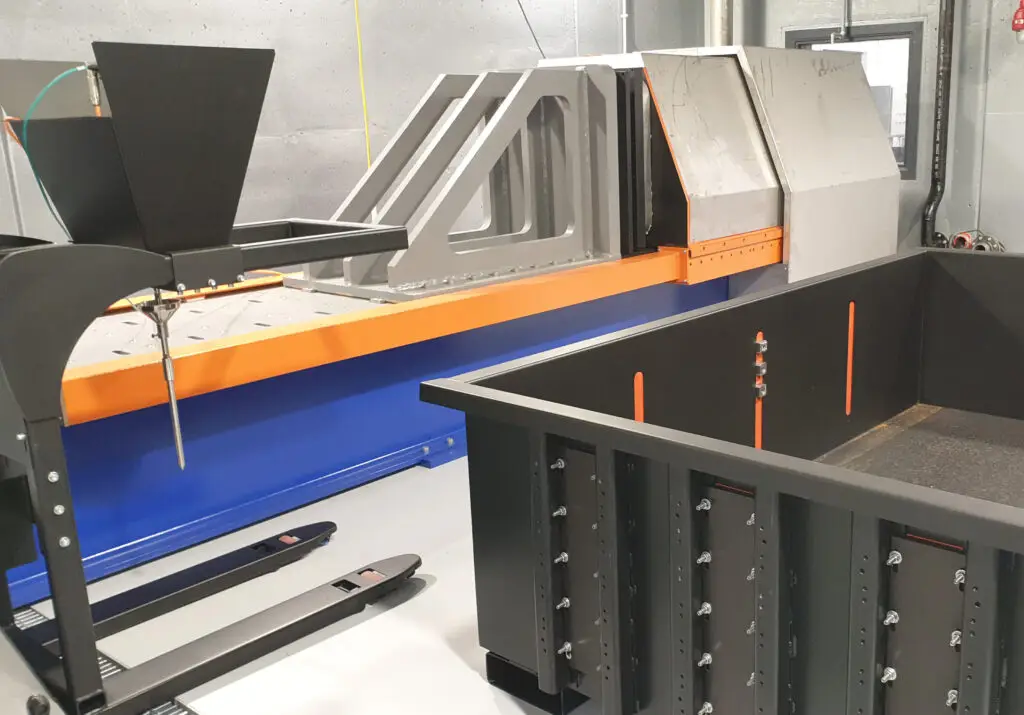
Nail Penetration Test Systems
Advantages of Nail Penetration Systems
Comprehensive Data
Data from electric servoelectric systems provides comprehensive insights into operations. During battery nail penetration testing, high-resolution force, position, and speed data are captured to support detailed failure analysis and safety validation. This information enables real-time monitoring, predictive maintenance, and overall optimization, offering a cleaner and more efficient alternative to hydraulic systems.
Repeatability and Precision Controls
Precise control ensures repeatable performance, consistently penetrating cells with a 3 mm tapered point at 8 cm/s or faster, and modules/packs with a 20 mm point at the same speed, achieving thorough testing depth. This repeatability is key for reliable assessment of battery resilience, uniformly testing through individual cells or across 100 mm in larger modules/packs, providing dependable safety evaluations.
SAE J2464 Compliance
Compliant with 4.3.3 Penetration Test (Cell Level or Above) and compliant with section 4.3.6 Crush Test (Cell, Module, or Pack Level).
Solid Welded Construction
Precision CNC machined and ground surfaces to 0.0001” tolerances ensure perfect alignment for system longevity. The rigid welded structure provides the stability required for high-force nail penetration testing while maintaining precise nail alignment throughout the test event. Nickel plating surfaces resist long-term corrosion better than zinc, powder-coating, or paint.
Enhanced Safety
Prioritize safety with advanced features, including real-time monitoring, automatic operation halts for detected risks, and adjustable depth controls. These measures not only protect operators but also create a safer working environment.
Advantages of Nail Penetration
Comprehensive Data
Data from electric servoelectric systems provides comprehensive insights into operations. This information enables real-time monitoring, predictive maintenance, and overall optimization, offering a cleaner and more efficient alternative to hydraulic systems.
Repeatability and Precision Controls
Precise control ensures repeatable performance, consistently penetrating cells with a 3 mm tapered point at 8 cm/s or faster, and modules/packs with a 20 mm point at the same speed, achieving thorough testing depth. This repeatability is key for reliable assessment of battery resilience, uniformly testing through individual cells or across 100 mm in larger modules/packs, providing dependable safety evaluations.
SAE J2646 Compliance
Compliant with 4.3.3 Penetration Test (Cell Level or Above) and compliant with section 4.3.6 Crush Test (Cell, Module, or Pack Level).
Solid Welded Construction
Precision CNC machined and ground surfaces to 0.0001” tolerances to ensure perfect alignment for system longevity. Nickel plating surfaces resist long-term corrosion better than zinc, powder-coating or paint.
Enhanced Safety
Prioritize safety with advanced features, including real-time monitoring, automatic operation halts for detected risks, and adjustable depth controls. These measures not only protect operators but also create a safer working environment.
Advantages of Nail Penetration
Comprehensive Data
Data from electric servoelectric systems provides comprehensive insights into operations. During battery nail penetration testing, high-resolution force, position, and speed data are captured to support detailed failure analysis and safety validation. This information enables real-time monitoring, predictive maintenance, and overall optimization, offering a cleaner and more efficient alternative to hydraulic systems.
Repeatability and Precision Controls
Precise control ensures repeatable performance, consistently penetrating cells with a 3 mm tapered point at 8 cm/s or faster, and modules/packs with a 20 mm point at the same speed, achieving thorough testing depth. This repeatability is key for reliable assessment of battery resilience, uniformly testing through individual cells or across 100 mm in larger modules/packs, providing dependable safety evaluations.
SAE J2464 Compliance
Compliant with 4.3.3 Penetration Test (Cell Level or Above) and compliant with section 4.3.6 Crush Test (Cell, Module, or Pack Level).
Solid Welded Construction
Precision CNC machined and ground surfaces to 0.0001” tolerances ensure perfect alignment for system longevity. The rigid welded structure provides the stability required for high-force nail penetration testing while maintaining precise nail alignment throughout the test event. Nickel plating surfaces resist long-term corrosion better than zinc, powder-coating, or paint.
Enhanced Safety
Prioritize safety with advanced features, including real-time monitoring, automatic operation halts for detected risks, and adjustable depth controls. These measures not only protect operators but also create a safer working environment.
Frequently Asked Questions
Battery nail penetration testing is used to deliberately create an internal short circuit inside a lithium-ion battery. The goal is to observe how the battery responds when a worst-case mechanical failure occurs, including heat generation, thermal runaway behavior, and how damage propagates through the cell or pack.
A nail penetration tester drives a conductive nail into a battery at a controlled speed, depth, and alignment. In real testing, consistency matters more than force alone. These systems are designed to ensure the penetration event is repeatable and that the test can be conducted safely when failure is expected.
Nail penetration testing is commonly used during battery safety validation and design development. It is often part of a broader mechanical abuse program used to understand failure behavior, compare design changes, or document safety performance for internal or regulatory purposes.
Nail penetration testing is commonly associated with SAE J2464, particularly the penetration test described at the cell level and above. These procedures are widely referenced in electric vehicle battery safety development and internal validation programs.
Nail penetration systems can be configured to test individual cells, battery modules, or full battery packs. Test parameters such as penetration speed, nail geometry, and travel depth are adjusted based on the battery format and the objectives of the test.
During a test, systems typically record penetration force, nail position, speed, depth, and event timing. This information allows engineers to correlate mechanical intrusion with internal shorting, heat generation, and the onset of failure.
They can, and often are. Load frames are commonly used in production environments where automated or semi-automated testing is needed to verify strength or durability without slowing throughput. Their consistency makes them easier to standardize across stations.
Yes. Nail penetration testing is intentionally destructive. The test is designed to push the battery into a severe failure condition so engineers can observe and evaluate its safety response under extreme abuse.
Nail penetration testing is commonly performed by electric vehicle OEMs, Tier 1 suppliers, battery manufacturers, automotive safety laboratories, and research teams focused on battery failure analysis and safety improvement.
Nail penetration testing creates a localized internal short circuit by puncturing the battery with a conductive object. Crush testing applies compressive force over a broader area. Both tests simulate mechanical abuse, but they target different failure mechanisms and are often used together to build a complete safety picture.