General Purpose Electric Linear Actuators (GPE)
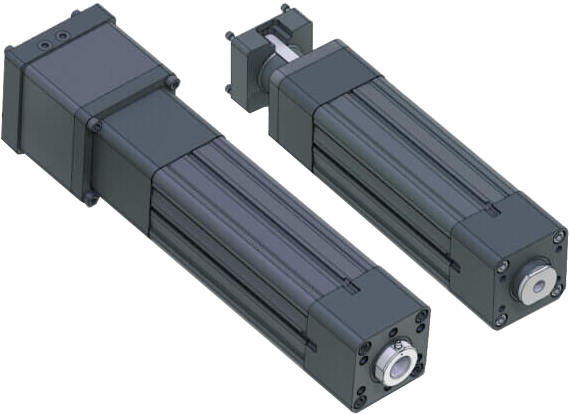
General Purpose Electric Linear Actuators (GPE)
General Purpose Electric Linear Actuators for Industrial Testing and Automation
For general purpose linear motion testing applications, these electric linear actuators provide a cost-effective, high-performance alternative to traditional pneumatic and hydraulic cylinders.
The electric linear actuators feature roller screw linear motion driven by either integrated or belt coupled servo motors.
Servo Controls
Directly compatible with eMcontrol servo controls with Profinet or EtherCAT digital technology takes advantage of digital communications and high resolution command, feedback, and servo drive extended functionality and diagnostics.
Ideal Applications
Ideal for test labs that need to reconfigure test applications on a regular basis, or for applications where the extended performance of the seaPLUS systems is not warranted. These industrial linear actuators are commonly used in R&D, durability testing, component validation, and generalpurpose automation environments.
Force and Stroke Configurations
Various force and stroke configurations are available in Low (0-2kN), Medium (2kN-18kN), High (18kN-55kN), and Extra High (55kN-294kN) Force ranges, allowing electric servo actuators to be matched precisely to application load requirements.
Internal Oil Coolers
Available with internal oil coolers to extend the continuous duty rating for durability applications.
Standard Linkages
For use with standard Rod End, Ball Joint, or other standard linkages.
Expandable and Scalable
Expandable and scalable system that provides the ability to add more actuators and drives in the future, making these electric linear actuators suitable for evolving test systems and modular industrial automation platforms.
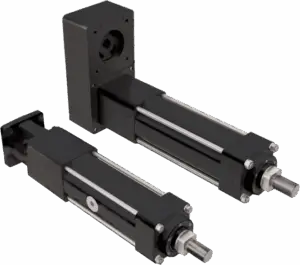
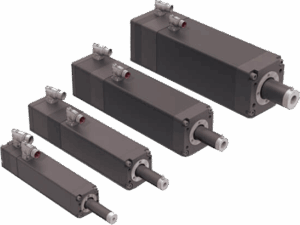
General Purpose Electric Linear Actuators for Industrial Testing and Automation
For general purpose linear motion testing applications, these electric linear actuators provide a cost-effective, high-performance alternative to traditional pneumatic and hydraulic cylinders.
The electric linear actuators feature roller screw linear motion driven by either integrated or belt coupled servo motors.
Servo Controls
Directly compatible with eMcontrol servo controls with Profinet or EtherCAT digital technology takes advantage of digital communications and high resolution command, feedback, and servo drive extended functionality and diagnostics.
Standard Linkages
For use with standard Rod End, Ball Joint, or other standard linkages.
Ideal Applications
Ideal for test labs that need to reconfigure test applications on a regular basis, or for applications where the extended performance of the seaPLUS systems is not warranted. These industrial linear actuators are commonly used in R&D, durability testing, component validation, and general purpose automation environments.
Force and Stroke Configurations
Various force and stroke configurations are available in Low (0-2kN), Medium (2kN-18kN), High (18kN-55kN), and Extra High (55kN-294kN) Force ranges, allowing electric servo actuators to be matched precisely to application load requirements.
Internal Oil Coolers
Available with internal oil coolers to extend the continuous duty rating for durability applications.
Expandable and Scalable
Expandable and scalable system that provides the ability to add more actuators and drives in the future, making these electric linear actuators suitable for evolving test systems and modular industrial automation platforms.
Electric Servo Actuators for Test and Industrial Applications
Electric servo actuators combine precise motion control, high force density, and clean operation, making them ideal for industrial linear actuator applications where accuracy and repeatability are critical. Unlike pneumatic or hydraulic systems, electric servo actuators provide programmable motion profiles, real-time feedback, and simplified system integration, reducing maintenance and improving test consistency.
These electric servo actuators are commonly deployed in test laboratories, industrial automation systems, and component validation setups where flexible, reconfigurable linear motion is required.
Electric Servo Actuators for Test and Industrial Applications
Electric servo actuators combine precise motion control, high force density, and clean operation, making them ideal for industrial linear actuator applications where accuracy and repeatability are critical. Unlike pneumatic or hydraulic systems, electric servo actuators provide programmable motion profiles, real-time feedback, and simplified system integration, reducing maintenance and improving test consistency.
These electric servo actuators are commonly deployed in test laboratories, industrial automation systems, and component validation setups where flexible, reconfigurable linear motion is required.
Frequently Asked Questions
Frequently Asked Questions
Electric linear actuators convert the rotary motion of an electric motor into controlled straight-line movement. In real applications, they are used when engineers need accurate control of force, position, or speed without dealing with the complexity of hydraulic or pneumatic systems.
An electric linear actuator describes the mechanical device that produces linear motion. A servo actuator is a specific type that uses a servo motor and closed-loop feedback. That feedback allows much tighter control of force, position, and velocity, which is why servo actuators are typically chosen for testing and precision applications.
These actuators show up in test and validation systems, durability and fatigue testing, industrial automation, component loading, and research environments. They are often selected because they are clean, easy to integrate, and capable of very repeatable motion.
Electric actuators avoid many of the drawbacks of fluid-based systems. They operate cleanly, require less routine maintenance, and offer precise programmable control. Eliminating hydraulic power units, compressors, and fluid handling also simplifies installation and long-term operation.
Electric servo actuators are available across a wide range of force capacities, from relatively low-force applications to very high-force industrial use. Choosing the right force range is important, since oversizing or undersizing an actuator can affect performance, efficiency, and service life.
They can, provided the actuator is designed for the duty cycle. Features such as internal oil cooling or enhanced thermal management allow electric actuators to maintain consistent performance during extended or high-cycle testing programs.
Electric servo actuators are well suited for reconfigurable environments. Modular mounting options, standard linkages, and scalable control systems make it relatively easy to adapt an actuator to new test articles or evolving requirements without replacing the entire system.
They are usually paired with real-time servo controllers that support industrial communication protocols like PROFINET and EtherCAT. These controllers provide closed-loop control, diagnostics, and integration with larger test or automation systems.
Compared to hydraulic systems, maintenance demands are generally lower. Typical upkeep includes routine inspection, lubrication of mechanical components when required, and monitoring of servo drives and any cooling systems to ensure long-term reliability.
Electric linear and servo actuators are widely used in automotive, aerospace, industrial manufacturing, energy, and research environments. Any application that requires precise, repeatable linear motion without fluid power is a strong candidate for electric actuation.